
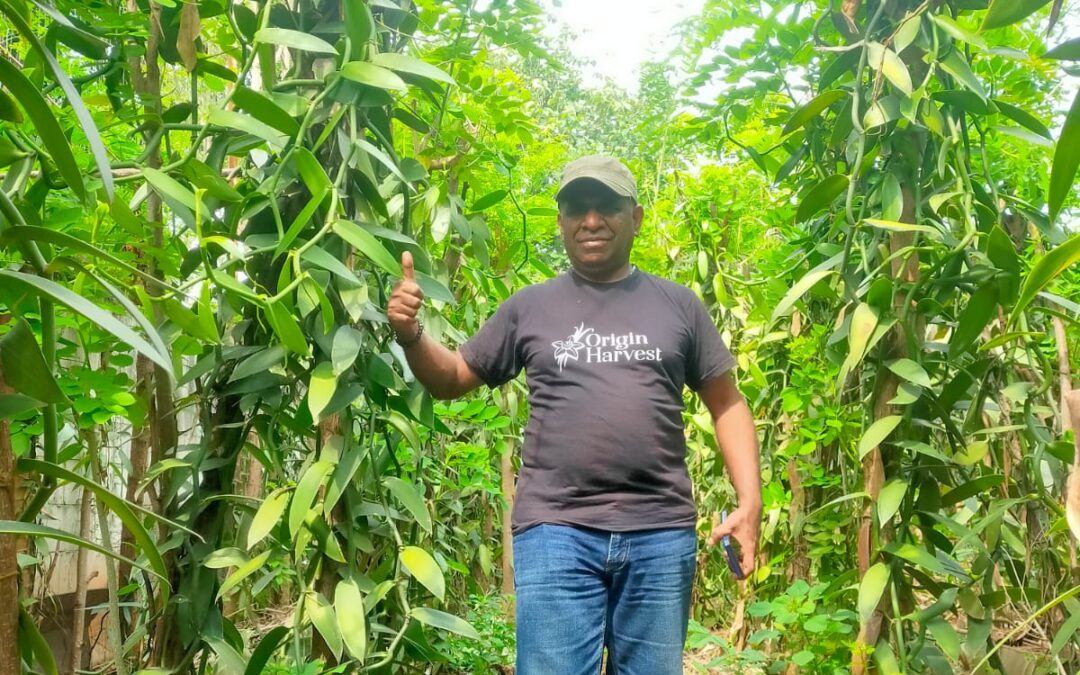
Vanilla bean farmers around the world dedicate their lives to caring for what is often called “green gold.” They navigate strict growing requirements that are closely tied to the surrounding natural environment, and their responsibilities go far beyond simply planting and watering. A vanilla farmer is accountable for the health of the vine from the moment of planting, through the critical window of hand pollination, all the way to the careful harvesting and curing of each individual pod.
Vanilla bean farmers must also educate and train junior farmers within their operations to ensure that cultivation practices remain consistent and sustainable across generations. Vanilla is a plant that produces ingredients essential to multiple global industries, from food and beverage to cosmetics and pharmaceuticals. Demand remains high, and scarcity can arise quickly due to weather events, disease, or disruptions in the pollination cycle. This is why those who care for this remarkable spice plant must possess exceptional levels of patience, discipline, and technical knowledge.
Contents
- 1 Vanilla Bean Farmers and the Glory of Their Services
- 2 Countries with Abundant Vanilla Production and the Most Vanilla Bean Farmers
- 3 Top Vanilla Producing Countries at a Glance
- 4 Challenges of Becoming a Vanilla Bean Farmer
- 5 The Planting and Harvesting Process for Vanilla Bean Farmers
- 6 Origin Harvest: Supporting Vanilla Bean Farmers in Indonesia
- 7 Frequently Asked Questions About Vanilla Bean Farmers
- 7.1 Why do vanilla bean farmers have to hand-pollinate the flowers?
- 7.2 How long does it take to grow vanilla beans from planting to harvest?
- 7.3 What makes Indonesian vanilla different from Madagascar vanilla?
- 7.4 What is the sweating stage in vanilla curing, and why is it important?
- 7.5 Why is vanilla farming considered more labor-intensive than other crops?
- 7.6 How does the quality of farming practices affect the final vanilla bean quality?
Vanilla Bean Farmers and the Glory of Their Services
History tells us that originally, the pollination of vanilla plants in their native habitat could only occur through the contribution of specific native bee species in the Mesoamerican region. Unfortunately, these pollinators do not exist in the many tropical countries where vanilla has since been introduced. As a result, the pollination method was adapted to require the direct intervention of vanilla bean farmers, who must perform the delicate work of hand pollination flower by flower, every single day during the blooming season.
These farmers are quiet heroes of the global agricultural story. From the Neolithic era, when farming first emerged as a means of sustaining human communities, to the highly specialized and globally connected agricultural supply chains of today, farmers have always been the foundation on which food security rests. For vanilla, whose cultivation demands more skill, patience, and precision than almost any other crop, this is especially true.
In countries where agriculture has become highly mechanized and the farming workforce has shrunk, vanilla remains nearly impossible to cultivate at scale due to both climate constraints and the irreplaceable need for skilled hand labor. This has driven the development of an international trade network for vanilla beans, with a small number of tropical countries supplying the entire global demand. To understand more about how this market operates and where it is heading, our global vanilla bean market overview provides a comprehensive picture.
Countries with Abundant Vanilla Production and the Most Vanilla Bean Farmers
While many nations have diversified their economies away from agriculture, there remain several tropical countries where vanilla farming is a cornerstone of the local economy and a source of livelihood for thousands of farming families. The following are the leading vanilla-producing countries in the world, each with a significant community of dedicated vanilla bean farmers.
Madagascar
Since the mid-19th century, when the hand-pollination technique developed by Edmond Albius in 1841 was adopted on the island, Madagascar has been at the center of global vanilla production. The country consistently supplies between 70 and 80 percent of the world’s vanilla, producing thousands of tons each year. Madagascar’s vanilla, primarily grown in the northeastern Sava region, is known for its rich, creamy, and classically sweet flavor profile. However, the country’s production is highly vulnerable to cyclones and extreme weather events, which can cause supply disruptions and sharp price increases on the global market.
Indonesia
Indonesia, often called the “Emerald of the Equator,” has a centuries-long tradition as one of the world’s great spice-producing nations. Vanilla was introduced to the country by Dutch botanists in 1819, with early cultivation established at the Bogor Botanical Gardens in Java. Since then, vanilla cultivation has spread across multiple Indonesian islands, benefiting from the country’s ideal tropical climate, fertile volcanic soil, and experienced farming communities.
Vanilla bean farmers in Indonesia are well-regarded for their patience and deep commitment to their craft. Indonesian vanilla has a distinctive character: bold, earthy, and smoky, with a strong and long-lasting fragrance that makes it particularly valued in extract production and blending applications. Indonesia consistently ranks as the world’s second largest vanilla producer, with annual production figures in the range of 2,000 to 2,500 tons in good harvest years.
Mexico
Mexico holds a place of unique significance in the vanilla world as the original homeland of the vanilla plant. The Totonac people of the Gulf Coast region were the first to cultivate vanilla, and Mexico’s planifolia vanilla is still prized today for its complex, spicy, and woody character that differs noticeably from the creamy profile of Bourbon-style beans. Mexican vanilla production, while smaller in volume than Madagascar and Indonesia, has seen positive growth in recent years as demand for origin-specific and artisan vanilla has increased globally. To learn more about vanilla’s origins in Mexico and its journey to the rest of the world, our article on vanilla bean history tells the full story.
Papua New Guinea
Papua New Guinea may produce smaller volumes than the top three producers, but its vanilla is consistently recognized for its superior quality. Many vanilla bean farmers in Papua New Guinea cultivate the Tahitian variety (Vanilla tahitensis), which is celebrated for its rich floral and fruity aroma and commands a premium price on the global market. The country’s pristine natural environment and traditional farming methods contribute to a product that stands out for its purity and aromatic complexity.
Other Producers
Other tropical countries including the Comoros, Uganda, Tonga, and French Polynesia also contribute to the global vanilla supply, each with their own distinct growing conditions and farming communities. The diversity of vanilla-producing origins gives buyers around the world the opportunity to select beans that match their specific flavor requirements and supply chain preferences.
Top Vanilla Producing Countries at a Glance
| Country | Vanilla Type | Flavor Profile | Global Role |
|---|---|---|---|
| Madagascar | Planifolia (Bourbon) | Rich, creamy, classically sweet | Largest producer, 70 to 80% of global supply |
| Indonesia | Planifolia and Tahitian | Bold, earthy, smoky, aromatic | Second largest producer, growing export market |
| Mexico | Planifolia (native origin) | Spicy, woody, complex | Original source, artisan and specialty market |
| Papua New Guinea | Planifolia and Tahitian | Floral, fruity, aromatic | Premium niche producer, high quality recognition |
| Comoros and Others | Planifolia (Bourbon) | Similar to Madagascar, slightly lighter | Supplementary Indian Ocean supply |
Challenges of Becoming a Vanilla Bean Farmer
Vanilla is one of the most demanding agricultural crops in the world to cultivate successfully. Despite its status as “green gold,” vanilla bean farmers face significant and ongoing challenges at every stage of production, including soil management, humidity control, temperature regulation, water supply, pest and disease management, and the unforgiving pollination window that gives farmers only a single day per flower to act.
Physical strength, perseverance, and extraordinary patience are non-negotiable qualities for anyone working in vanilla agriculture. Unlike many other crops, vanilla does not reward shortcuts. Every element of the process, from the quality of the soil preparation to the precision of the hand-pollination technique, has a direct and measurable impact on the final quality of the harvested pod.
The Planting and Harvesting Process for Vanilla Bean Farmers
The full journey from establishing a vanilla vine to harvesting mature pods is a long-term commitment. A vanilla vine typically takes two to three years from the time of planting before it produces its first flowers. After successful pollination, the pods require a further eight to nine months to mature fully on the vine. Understanding this timeline is essential for anyone sourcing vanilla from farms directly, as it explains why vanilla supply cannot respond quickly to sudden spikes in demand.
Planting
Vanilla thrives in tropical climates with temperatures consistently between 25°C and 30°C and high ambient humidity. The ideal soil is well-drained, rich in organic matter, and fertile. Vanilla is typically propagated through stem cuttings taken from established, healthy plants, which are then planted in prepared ground or raised growing structures.
The plants require a support structure to climb, such as a living tree or a constructed trellis, which helps train the vine to grow vertically and at a height that allows farmers comfortable access for daily pollination work during the flowering season. Plants are spaced approximately 2 to 3 meters apart to ensure adequate room for spreading and to allow good air circulation that reduces disease risk.
Pollination
In their native Mesoamerican habitat, vanilla flowers are pollinated by specific native bee species. Outside of this region, vanilla bean farmers must perform hand pollination manually, transferring pollen from the anther of the male part of the flower to the stigma of the female part using a thin sliver of bamboo or a similar small tool.
This pollination process must be completed early in the morning while the flowers are still freshly open. Each vanilla flower remains open and receptive for only a few hours on a single day before it closes and falls off the vine. Any flower that is not pollinated within this window will not produce a pod. This is why vanilla farming requires daily farm visits and a dedicated workforce during the entire flowering season.
Growing and Maintenance
After successful pollination, the vanilla pods take approximately eight to nine months to reach full maturity on the vine. During this growing period, farmers must water the plants regularly, apply organic fertilizer to maintain soil nutrition, prune the vines to encourage healthy growth, and monitor closely for signs of disease or pest activity. Vanilla vines are susceptible to root rot, fungal disease, and several types of pests, all of which require prompt and careful management to protect the harvest.
Harvesting
Harvesting occurs when the vanilla pods are fully ripe, which is indicated by the tips of the pods beginning to turn slightly yellow. Timing is critical: pods harvested too early will not develop their characteristic vanilla aroma during the curing process, while pods left too long on the vine risk splitting. Farmers harvest by hand, carefully cutting each pod from the vine with a clean blade. The pods are soft and must be handled with great care to avoid bruising, which can create entry points for mold during curing.
The Curing and Preservation Process
Freshly harvested vanilla pods have virtually no vanilla aroma. The characteristic fragrance develops entirely during the post-harvest curing process, which typically involves the following stages:
- Blanching: The pods are briefly immersed in hot water for approximately 3 minutes to stop enzymatic activity and begin the process of breaking down the cell walls that release the flavor compounds.
- Sweating: The blanched pods are wrapped in blankets or placed in sealed boxes in a warm environment for one to two days. This sweating phase accelerates the enzymatic conversion of glucovanillin into vanillin, the primary aromatic compound.
- Sun drying: The pods are spread on drying racks and exposed to direct sunlight for several hours each day over a period of weeks, alternating between sun exposure and shade to prevent cracking.
- Shade drying and conditioning: The pods are moved to a cool, dark, well-ventilated space for a final conditioning period of one to two months, during which their moisture content stabilizes and the full aroma profile develops.
This entire curing process is what transforms a green, odorless pod into the dark, oily, and intensely fragrant vanilla bean that arrives at your door. The quality of the curing directly determines the quality of the finished product.
Origin Harvest: Supporting Vanilla Bean Farmers in Indonesia
Origin Harvest is a vanilla producer based in Indonesia that works directly with local farming communities to source and export premium planifolia and Tahitian vanilla beans. We have been active in the vanilla export business for over ten years, serving buyers across Europe, North America, and Asia Pacific.
Our farmers treat every vine and every pod with the same level of care and dedication described in this article. Our unique multi-step drying process ensures that the vanilla we supply maintains the highest possible quality from farm to shipment. We use four layers of protective packaging to ensure every order arrives in prime condition, whether shipped by air freight or sea freight.
We offer multiple product grades, from luxury grade whole pods to extract grade beans, as well as chopped vanilla, vanilla powder, and vanilla extract, with a minimum order of just 5 kilograms. Every shipment comes with full phytosanitary certification. If you are looking for a reliable vanilla supplier who stands behind the work of its farmers, we invite you to reach out and discuss your requirements with our team.
Frequently Asked Questions About Vanilla Bean Farmers
Why do vanilla bean farmers have to hand-pollinate the flowers?
Vanilla orchids in their native Mesoamerican habitat are pollinated by specific native bee species that are not found in other parts of the world where vanilla is now cultivated. When vanilla plants were introduced to countries like Madagascar, Indonesia, and Papua New Guinea, these natural pollinators were absent. Without pollination, the flowers fall off the vine without producing any pods. The discovery of a practical hand-pollination technique by Edmond Albius in 1841 solved this problem and made commercial vanilla cultivation outside of Mexico possible for the first time. Since then, hand pollination has been the standard practice for vanilla farmers in all major producing countries.
How long does it take to grow vanilla beans from planting to harvest?
The full timeline from planting a vanilla vine to the first harvestable pods is substantial. The vine itself takes two to three years from the time of planting before it produces its first flowers. After successful hand pollination, the developing pods take a further eight to nine months to fully mature on the vine before they are ready for harvest. After harvest, the curing and drying process takes an additional three to six months before the pods are ready for sale. This means that the total time from a new planting to a finished, market-ready vanilla bean can be as long as four to five years, which is a key reason why vanilla remains one of the most expensive spices in the world.
What makes Indonesian vanilla different from Madagascar vanilla?
Both Indonesian and Madagascar vanilla come from the same species, Vanilla planifolia, but their flavor profiles differ because of the different growing environments, soil compositions, and curing methods used in each country. Madagascar Bourbon vanilla is known for its rich, creamy, and classically sweet flavor that is widely considered the benchmark for premium vanilla in baking and confectionery. Indonesian vanilla tends to have a bolder, earthier, and smokier character that performs particularly well in extract production and applications where a more robust and assertive vanilla presence is desired. Many food manufacturers use Indonesian vanilla as a high-quality and cost-effective alternative or complement to Madagascar beans.
What is the sweating stage in vanilla curing, and why is it important?
The sweating stage is a critical phase in vanilla bean curing that takes place immediately after the initial blanching step. During sweating, the freshly blanched pods are wrapped in thick cloth or placed in insulated wooden boxes in a warm environment for one to two days. The heat and humidity created within the wrapping triggers enzymatic activity inside the pod that converts glucovanillin, a naturally occurring compound, into vanillin, which is the primary aromatic compound responsible for the characteristic vanilla scent. Without this sweating phase, the pods would not develop their signature fragrance during the subsequent drying stages. The quality and consistency of the sweating process is one of the key factors that distinguishes a highly experienced curing operation from a less skilled one.
Why is vanilla farming considered more labor-intensive than other crops?
Vanilla farming requires a higher level of daily human involvement than almost any other commercial crop. During the flowering season, every flower on every vine must be individually hand-pollinated within a single morning, as each flower is only open and receptive for a few hours. This requires a large and coordinated workforce that can cover the entire plantation within the available pollination window each day. Beyond pollination, the plants require regular pruning, careful watering, and vigilant monitoring for disease. After harvest, the multi-stage curing process involving blanching, sweating, sun drying, and conditioning also demands daily attention over a period of several months. The combination of these factors makes vanilla one of the most time-intensive and labor-dependent agricultural products in the world.
How does the quality of farming practices affect the final vanilla bean quality?
The quality of farming practices has a direct and significant impact on every measurable quality indicator of the finished vanilla bean, including vanillin content, moisture level, pod length, aroma intensity, and visual appearance. Well-managed soil with adequate organic matter produces vines that grow vigorously and flower abundantly. Precise hand pollination at the correct stage of flower development results in well-formed, fully developed pods. Careful harvesting at exactly the right moment of ripeness ensures that the pods have the maximum potential for vanillin development during curing. And a properly executed curing process with controlled sweating and drying conditions produces beans with consistent moisture content and a rich, stable aroma. Every stage of farming influences the next, which is why the relationship between buyer and farmer is so important in the vanilla supply chain.
Reviewed and updated by the Origin Harvest Editorial Team on May 20, 2026. This article covers the role and challenges of vanilla bean farmers worldwide, the cultivation and curing process from planting to finished pod, and an overview of the top vanilla-producing countries including Madagascar, Indonesia, Mexico, and Papua New Guinea. Content is prepared to provide accurate and practical information for culinary professionals, food manufacturers, and vanilla enthusiasts sourcing premium vanilla beans from Indonesia.